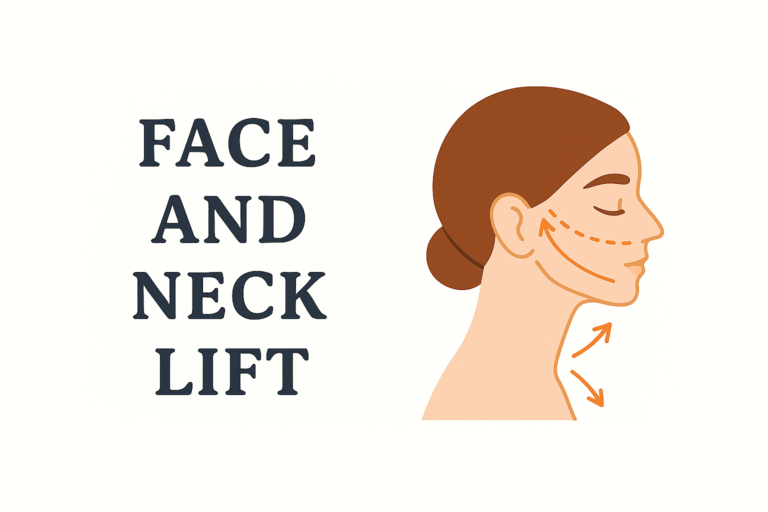
Deep Plane Facelift & Neck Lift
Advanced Facial Rejuvenation by a Consultant Plastic Surgeon
A facelift is one of the most powerful procedures available for restoring a youthful, refreshed appearance. Mr Ahmed Ibrahim is a Consultant Plastic and Reconstructive Surgeon with specialist training in advanced facelift surgery, including the Deep Plane Facelift and Deep Plane Neck Lift.
Having undertaken training with internationally recognised leaders in facial aesthetic surgery and deep plane techniques, Mr Ibrahim offers modern facial rejuvenation procedures designed to restore natural facial contours while avoiding an operated or overly tight appearance.
His approach focuses on repositioning the deeper structures of the face and neck rather than simply tightening the skin, creating elegant, long-lasting and natural-looking results.
Why Choose a Deep Plane Facelift?
As we age, the deeper tissues of the face gradually descend. This leads to:
- Jowls along the jawline
- Deepening of the nasolabial folds
- Loss of cheek volume and contour
- Sagging around the lower face
- Neck laxity and platysmal banding
A traditional facelift primarily addresses these changes through tightening of the SMAS layer. A Deep Plane Facelift goes further by releasing and repositioning the facial soft tissues as a single unit.
This allows the cheeks, jawline and neck to be elevated in a more anatomical manner, often producing a softer and more natural rejuvenation without excessive tension on the skin.
The technique is particularly effective for:
- Midface rejuvenation
- Restoration of youthful cheek contours
- Improvement of nasolabial folds
- Correction of jowls
- Definition of the jawline
- Comprehensive neck rejuvenation
Deep Plane Neck Lift
The neck is often one of the first areas to reveal signs of ageing. Many patients are concerned by:
- Loose neck skin
- Loss of jawline definition
- Platysmal bands
- Fullness beneath the chin
Mr Ibrahim frequently combines a Deep Plane Facelift with a Deep Plane Neck Lift to achieve harmonious rejuvenation of both the face and neck.
This may involve:
- Deep neck contouring
- Removal of excess fat beneath the chin
- Platysma muscle tightening
- Restoration of cervicomental angle definition
- Re-draping of neck tissues with minimal tension
The result is a smoother neckline and a more youthful transition between the face and neck.
Specialist Training and Expertise
Mr Ibrahim is a Consultant Plastic Surgeon with extensive training in aesthetic, reconstructive and microsurgical procedures. Alongside his NHS Consultant practice, he has pursued advanced education in facial rejuvenation surgery with leading facial plastic and aesthetic surgeons internationally.
His particular interest lies in modern facelift surgery, including:
- Deep Plane Facelift
- Deep Plane Neck Lift
- Brow Lift Surgery
- Eyelid Surgery (Blepharoplasty)
- Facial Fat Grafting
- Comprehensive facial rejuvenation procedures
Every treatment plan is tailored to the individual, recognising that facial ageing affects every patient differently.
The Consultation
A detailed consultation is essential to achieving excellent results.
During your appointment, Mr Ibrahim will assess:
- Facial proportions
- Skin quality and elasticity
- Facial volume loss
- Neck anatomy
- Jawline definition
- Your aesthetic goals
A personalised treatment plan will then be developed, which may include a Deep Plane Facelift alone or in combination with other procedures such as neck lift, brow lift, eyelid surgery or facial fat grafting.
Recovery
Most patients can expect:
- Bruising and swelling for 2–3 weeks
- Return to social activities after approximately 2–3 weeks
- Progressive refinement of results over several months
- Long-lasting rejuvenation with continued natural ageing
Full healing continues for several months as swelling settles and tissues soften.
Expected Results
The goal of a Deep Plane Facelift is not to change your appearance, but to restore a fresher, younger version of yourself.
Patients typically notice:
- Improved jawline definition
- Restoration of cheek volume and contour
- Reduction of jowls
- Smoother neck contours
- A rested, refreshed appearance
- Natural-looking rejuvenation without a pulled appearance
Results are long-lasting and age gracefully over time.
Why Patients Choose Mr Ibrahim
- Consultant Plastic Surgeon on the GMC Specialist Register
- Specialist training in Deep Plane Facelift techniques
- Training with internationally recognised leaders in facial aesthetic surgery
- Expertise in both aesthetic and reconstructive surgery
- Personalised treatment plans
- Natural-looking results focused on facial harmony and balance
FAQ
1. What is the main difference between a Deep Plane and a SMAS facelift?
The key difference is the depth of dissection and tissue release. In a SMAS lift, the SMAS layer is tightened. In a Deep Plane lift, the surgeon works beneath the SMAS, releasing and lifting the deep fat pads of the cheek along with the overlying muscles as one unit. This can allow for a more powerful repositioning of the mid-face with less tension on the skin.
2. Why might Mr Ibrahim recommend a Deep Plane facelift for me?
He may recommend it if you have significant descent of the mid-face (deep nasolabial folds, fallen cheek volume) and desire a very natural, long-lasting rejuvenation. It is also an excellent technique for patients with heavier facial tissues. He will recommend the technique that best addresses your specific aging pattern.
3. Does a Deep Plane facelift have a higher risk?
As a more advanced dissection, it carries a theoretically increased risk of temporary nerve weakness due to the deeper manipulation near motor nerves. However, in the hands of a highly trained and experienced surgeon like Mr Ibrahim, who has an intimate knowledge of facial anatomy, the procedure is very safe. The risk profile will be discussed in detail during your consultation.
4. How long do the results of a Deep Plane facelift last?
Both SMAS and Deep Plane facelifts offer long-lasting results, typically 10 years or more. The Deep Plane technique may provide exceptional longevity in the mid-face area due to the complete repositioning of deep tissues. Your lifestyle and genetics will also influence duration.
5. Where are the scars, and will they be visible?
Scars are strategically placed: in the natural crease in front of the ear, around the earlobe, behind the ear in the shadowed fold, and possibly extending minimally into the hairline. Meticulous closure ensures these scars mature into fine, inconspicuous lines over 12-18 months, easily concealed by hair and makeup.
6. What is recovery like compared to a SMAS lift?
Initial recovery is similar. Some patients undergoing Deep Plane technique may have slightly more swelling in the mid-cheek area initially, which resolves. The overall timeline for returning to normal activities is comparable.
7. Can a facelift be combined with other procedures?
Yes, it is commonly combined with:
Eyelid surgery (Blepharoplasty): To address aging around the eyes.
Brow lift: To elevate a sagging forehead.
Facial lipomodelling (fat transfer): To restore volume in the cheeks, lips, or temples.
Skin resurfacing (laser/peel): To improve skin texture and fine lines.
8. Is there an age limit for a facelift?
There is no strict age limit. The decision is based on biological age, skin quality, and overall health, not chronological age. Patients in their 40s to 70s are common candidates, provided they are healthy and have realistic goals.