Congenital & Developmental Breast Deformities
Expert Correction of Complex Breast Conditions
Every woman’s body is unique, and sometimes breast development does not follow the typical pattern due to congenital conditions or variations. These conditions can affect appearance, self-confidence, and sometimes physical comfort. Mr Ibrahim specialises in the surgical correction of a range of complex breast deformities, aiming to create a more symmetrical, natural, and balanced contour.
Conditions Treated:
- Tuberous Breast Deformity (Constricted Breast):
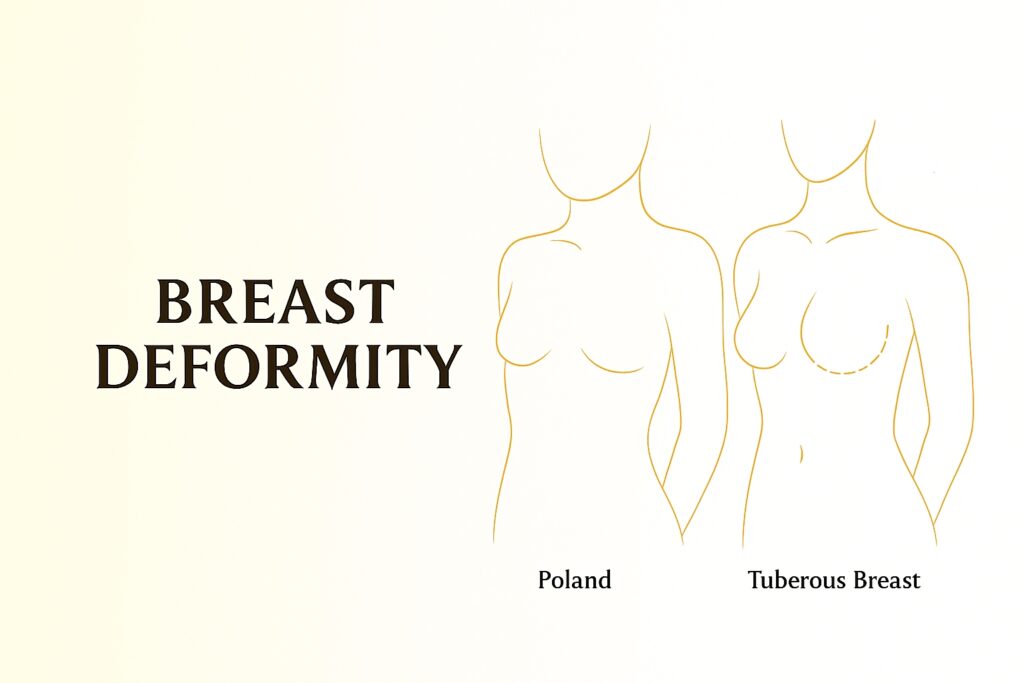
- What it is: A congenital condition where the breast base is constricted, the lower pole is underdeveloped, and the areola may be enlarged and herniated. Breasts can appear tubular, asymmetric, or excessively spaced.
- Surgical Approach: Correction is complex and tailored. It often involves releasing the constricted tissue, reshaping the breast gland, reducing the areola size, and almost always using a breast implant to provide volume and projection in the lower pole. The goal is to create a rounded, natural breast shape.
- Poland Syndrome:
- What it is: A rare birth defect characterised by underdevelopment or absence of the chest muscle (pectoralis major) on one side, often associated with underdevelopment of the breast and sometimes hand anomalies on the same side.
- Surgical Approach: Treatment is highly individualised. For women, it typically involves breast reconstruction to match the opposite side. This may use a custom-shaped implant, a latissimus dorsi (LD) muscle flap from the back (which also replaces the missing chest muscle contour), or advanced microsurgical techniques like a DIEP flap for the most natural result.
- Pectus Excavatum:
- What it is: Conditions affecting the shape of the chest wall. Pectus excavatum (“funnel chest”) is a depression of the sternum.
- Surgical Approach: Mr Ibrahim works in collaboration with thoracic surgeons when major chest wall correction is needed. For breast aesthetics, the focus is on creating symmetry. This may involve custom implant placement to fill a depression, or breast reduction/augmentation on one side to balance the appearance of a protrusion. The surgery is carefully planned to complement the overall chest contour.
- Significant Breast Asymmetry:
- What it is: A noticeable difference in size, shape, or position between the two breasts.
- Surgical Approach: A combination of techniques is used on one or both breasts to achieve harmony. This could involve a different sized implant on each side, a reduction on the larger breast, a lift on the more ptotic (saggy) breast, or fat transfer.
Your Consultation for Breast Deformity Correction
Correcting these conditions requires meticulous planning and surgical artistry. During your consultation, Mr Ibrahim will conduct a detailed examination, discuss your concerns and goals, and explain the specific, staged surgical plan required to achieve the best possible outcome. These are some of the most challenging and rewarding procedures in plastic surgery, and his expertise ensures you are in capable and caring hands.
FAQ
1. What are the most common congenital breast deformities you treat?
Mr Ibrahim specialises in correcting Tuberous (Tubular) Breast Deformity (constricted breast base, high crease, herniated areola), Poland Syndrome (underdevelopment or absence of chest muscle and breast tissue), and asymmetry related to Pectus Excavatum (funnel chest).
2. At what age can these deformities be surgically corrected?
Surgery is typically deferred until breast development is complete, usually around age 16-18. This allows for a definitive assessment and a single, comprehensive corrective surgery.
3. How is tuberous breast deformity corrected?
Correction is complex and often involves multiple techniques: scoring the constricted breast tissue to allow expansion, lowering the inframammary fold, reducing a herniated areola, and almost always using an implant or fat grafting to create proper volume and projection.
4. What are the surgical options for Poland Syndrome?
Reconstruction depends on severity. Options include a custom-shaped implant to match the opposite side, latissimus dorsi (LD) muscle flap transfer from the back (with or without an implant) to replace missing muscle and add tissue, or microvascular free flap reconstruction for more severe cases.
5. Can pectus excavatum be corrected at the same time as breast asymmetry?
The chest wall deformity and breast asymmetry are addressed together. After having a CT scan, an implant is often custom-contoured or placed in a submuscular plane to help camouflage the sternal depression and create a symmetrical, natural-looking chest contour in relation to the other breast. Occasionally, another surgery is needed to address asymmetry, which can be addressed by breast implants, fat grafting or a combination of both techniques.
6. Will I need more than one operation?
For complex deformities like severe tuberous breasts or Poland syndrome, a staged approach is common. The first surgery creates a more normal breast shape and position using a tissue expander (temporary implant to expand the skin); a second stage may refine symmetry, adjust the nipple-areola complex, replacing tissue expander with a permenant implant or perform fat grafting for softening.
7. What are the realistic expectations for symmetry?
The goal is significant improvement and much greater symmetry, not perfection. The affected side may differ slightly in size, shape, or position from the natural breast. A procedure on the opposite breast (augmentation, reduction, or lift) is often recommended to achieve the best possible match.
8. Is this type of corrective surgery available on the NHS?
Surgery for significant congenital breast deformities that cause psychological distress is sometimes available on the NHS, your GP applies for funding approval and then can refer to Mr Ibrahim. Mr Ibrahim performs those procedures in both the NHS and the Private sector.