Restore a Youthful, Alert Expression
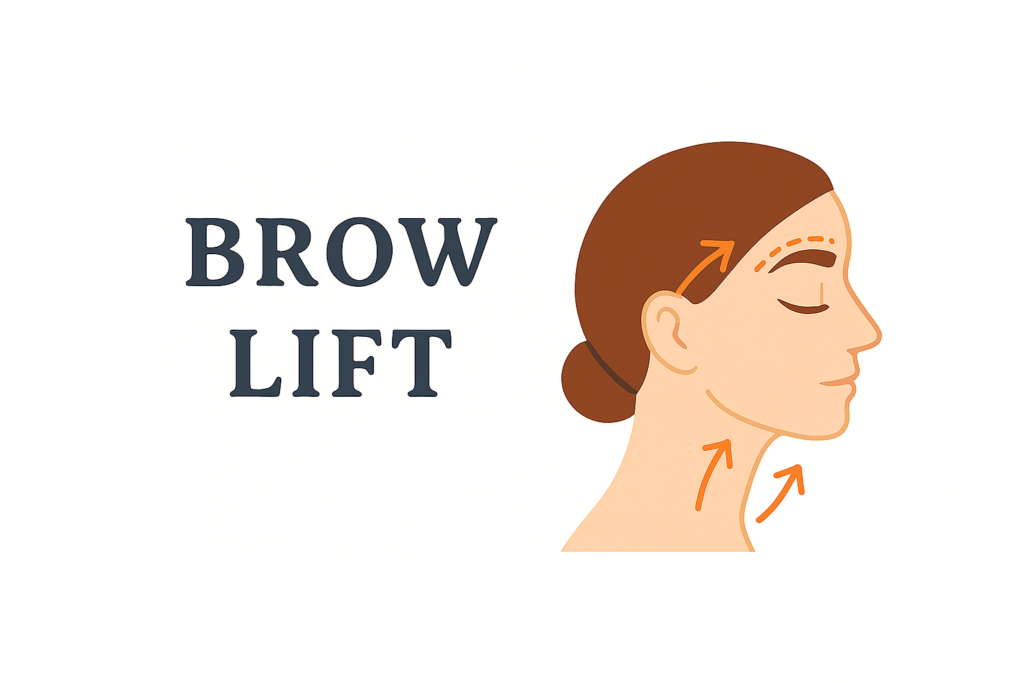
A brow lift, also known as a forehead lift, is a surgical procedure designed to correct a drooping or sagging brow. When the brow descends, it can create a tired, angry, or sad appearance and can even cause the upper eyelids to look hooded. By repositioning the brow to a more youthful, natural height, a brow lift can dramatically rejuvenate the upper third of the face, opening up the eye area and creating a more refreshed and approachable expression.
Mr Ahmed Ibrahim, a Consultant Plastic Surgeon, offers a range of brow lift techniques tailored to your unique facial anatomy, brow shape, and aesthetic goals. The goal is always a natural, harmonious result—never an over-lifted “surprised” look.
Detailed Guide to Brow Lift Techniques
Endoscopic Brow Lift
This is the most common modern technique. Using a small camera (endoscope) inserted through tiny scalp incisions, Mr Ibrahim can visualise and adjust the muscles and tissues responsible for brow descent. The brow is lifted and secured in its new position, often with tiny, dissolvable fixation devices.
Ideal for: Patients with mild to moderate brow droop and a normal to high hairline who desire the smallest possible scars.
Direct Brow Lift
As described on your current page, this technique offers the most powerful and precise lift. It is particularly useful for men with heavy, low brows, for correcting significant asymmetry, or when other techniques have failed. The trade-off is a fine scar along the brow, which is expertly placed to be concealed within the brow hairs.
Ideal for: Patients with significant brow ptosis, thick skin, or those seeking a very powerful, durable correction.
Your Surgical Journey with Mr Ibrahim
Comprehensive Consultation: Mr Ibrahim will assess your facial anatomy, brow position, muscle strength, skin quality, and hairline. He will listen to your goals and recommend the single best technique—or combination of techniques—for your unique face. He will show you before-and-after photographs and explain the expected scar, recovery, and outcome in detail.
Personalised Surgical Plan: You will receive a clear, written plan outlining your chosen technique, anaesthesia (usually local with sedation or general), and the precise goals of your surgery.
The Procedure: Performed in an accredited private hospital. Operating time varies from 45 minutes (direct lift) to 2 hours (endoscopic lift).
Recovery & Aftercare: You will have some swelling and bruising around the eyes and forehead. Sutures are removed within 5-14 days, depending on the technique. You will receive detailed wound care and scar management instructions. Most patients return to non-strenuous work within 7-14 days.
FAQ
1. How is a direct brow lift different from other brow lift techniques?
The direct lift removes skin directly above the brow for maximum lift and precision, leaving a fine scar. Endoscopic lifts use tiny scalp incisions and are better for overall brow shaping. A temporal lift focuses on the outer brow tail. Mr Ibrahim will recommend the best technique for your anatomy.
2. What are the specific risks of a brow lift?
General surgical risks include bleeding, infection, and anaesthesia risks. Specific risks vary by technique but can include:
Numbness: Temporary or, rarely, permanent numbness of the forehead or scalp.
Asymmetry: A slight difference in brow height or shape.
Hair Loss: Temporary or, very rarely, permanent hair loss along the incision line.
Nerve Injury: Temporary weakness of the forehead muscles (e.g., inability to raise one eyebrow) which almost always resolves spontaneously over weeks to months.
Over-correction or Under-correction: The brow may be lifted too much (creating a “surprised” look) or not enough.
Visible Scarring: While incisions are placed discreetly, scars are permanent and their final appearance depends on your healing.
3. Is the procedure painful?
Discomfort is typically mild to moderate and well-controlled with prescribed pain medication in the first few days. Most patients describe a feeling of tightness rather than sharp pain.
4. What are the specific risks of this procedure?
As with all surgery, risks include bleeding, infection, and scarring. Specific risks include temporary or permanent numbness around the incision, subtle hair loss at the scar line, and asymmetry. Very rare risks include injury to deeper nerves that control eyebrow movement.
5. When will I see the final result?
While the lift is visible immediately after swelling subsides (around 2 weeks), the final, soft, natural appearance and the maturation of the scar can take 3-6 months.
6. How long do the results last?
The results are very long-lasting, often for many years. While the brow will continue to age naturally, it will remain in a higher, more youthful position than if you had never had the surgery.
7. Can I combine this with other facial procedures?
Yes, it is very commonly combined with upper eyelid surgery (blepharoplasty) to fully rejuvenate the upper third of the face. It can also be part of a more comprehensive facial rejuvenation plan.
8. What happens if I don't like the new brow position or shape?
Mr Ibrahim’s priority is achieving a natural, harmonious result based on your pre-operative planning. In the uncommon event of a minor asymmetry or over-correction, a subtle revision procedure may be possible once healing is complete.