Skin Lesion Excision Surgery
Expert Diagnosis and Surgical Management
Mr Ahmed Ibrahim is a Consultant Plastic Surgeon specialising in the excision and reconstruction of skin lesions, ranging from benign growths to skin cancers. He combines surgical expertise with a focus on optimal healing and aesthetic outcomes, whether using direct closure, skin grafts, or local flaps.
What is Skin Lesion Excision Surgery?
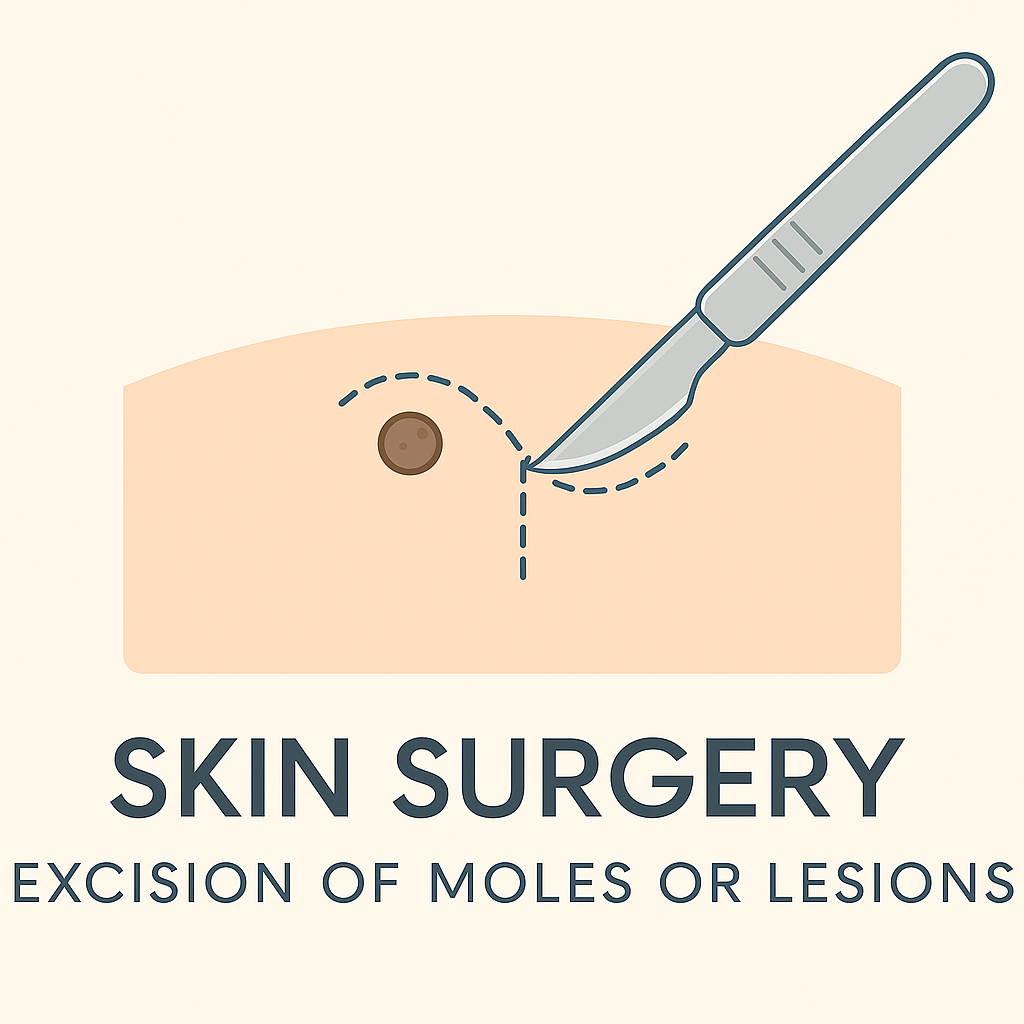
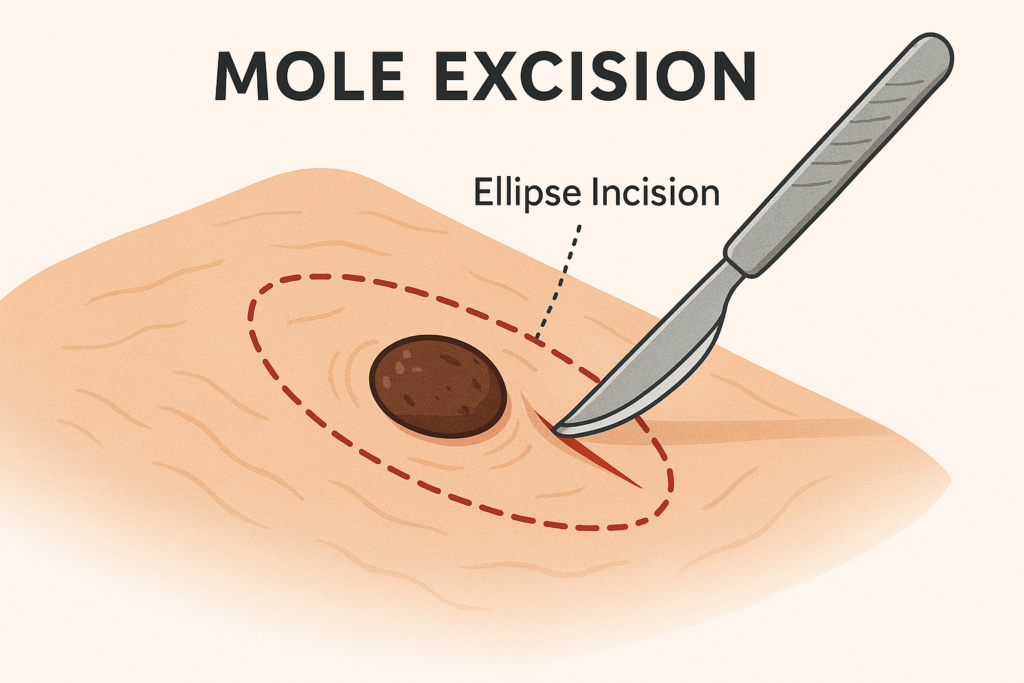
This procedure involves the complete surgical removal of a skin lesion with a margin of surrounding healthy tissue. The resulting wound is then closed using the most appropriate reconstructive technique:
Direct Closure: The wound edges are stitched together in a line. This is ideal for smaller lesions in areas with loose skin.
Skin Graft: A thin piece of skin is taken from a donor site (e.g., thigh or upper arm) and used to cover the wound. Used when the wound is too large to close directly.
Local Flap: Neighbouring skin, with its blood supply, is moved to fill the defect. This provides better colour and texture match than a graft and is used for more complex reconstructions, especially on the face.
The specimen is sent to a laboratory for histopathological analysis to confirm the diagnosis (biopsy) and ensure complete removal.
The Ideal Candidate
This surgery is for anyone with a skin lesion that requires removal for:
Medical Reasons: Confirmed or suspected skin cancer (e.g., Basal Cell Carcinoma, Squamous Cell Carcinoma), or a pre-cancerous lesion (e.g., Bowen’s disease).
Diagnostic Clarity: An uncertain lesion requiring a full biopsy.
Symptomatic Benign Lesions: Moles, cysts, or lipomas that are changing, bleeding, causing irritation, or are cosmetically concerning.
Your Surgical Journey with Mr Ibrahim
Consultation & Diagnosis: Mr Ibrahim will assess the lesion, discuss your history, and may arrange a preliminary biopsy. A treatment plan is then tailored, explaining why excision is needed and the planned reconstructive method.
Procedure: Performed under local anaesthesia (often with sedation for larger cases), the lesion is removed with an appropriate safety margin. Reconstruction is performed immediately. For grafts or complex flaps, the procedure takes longer.
Recovery: This varies by technique. For direct closure, care involves keeping the wound clean and dry. Grafts require careful protection of both the graft and donor site. Flaps need monitoring for blood supply. Strenuous activity is restricted for several weeks.
Results & Follow-up: The primary result is the complete removal of the lesion. The histology report, reviewed with you, confirms the diagnosis and clearance. Scarring is inevitable but minimised through precise plastic surgical techniques placed along natural skin lines where possible.
Realistic Expectations & Key Considerations
The primary goal is always the complete eradication of disease. The secondary goal is the best possible aesthetic and functional outcome. All closures leave a scar, which will mature and fade over 12-18 months. Mr Ibrahim will discuss all options, tailoring the reconstruction to your individual case to balance safety, function, and appearance.
FAQ
1. How do you decide which reconstruction method to use?
The choice depends on the lesion’s size, location, depth, and the surrounding skin’s laxity. Choosing the simplest effective technique, from direct closure to grafts and flaps, to achieve the best functional and cosmetic result. Mr Ibrahim will discuss the pros and cons of each technique to help reaching to an informed decision.
2. What are the specific risks of skin grafting?
Risks include partial or complete graft failure (where the graft does not “take”), colour mismatch, texture differences, and donor site scarring. The grafted area can also be more sensitive to temperature and sun exposure.
3. What are the specific risks of local flaps?
Flaps carry a risk of impaired blood supply, which can lead to partial flap loss, wound breakdown, or infection. There can also be swelling, bruising, and temporary or permanent numbness in the area. The scars are more complex than a simple line.
4. Will I have a large scar?
All excisions leave a scar. Mr Ibrahim, as a plastic surgeon, is specially trained to place incisions in the most discreet orientation and use layered closure techniques to produce the finest possible scar. The scar from removing a cancer will always be preferable to the consequences of leaving the disease.
5. How long does it take to get the biopsy results?
Histology results typically take 7-14 working days. Mr Ibrahim will ensure you receive these results clearly explained, detailing the diagnosis and confirming whether the lesion has been fully removed.
6. What if the results show the margins are not clear?
If the laboratory report indicates that the lesion (particularly a cancer) extends to the edge of the specimen, a further small operation may be recommended to excise an additional margin to ensure complete removal. This is a standard part of cancer management.
7. How long is the recovery for a skin graft or flap?
Recovery is longer than for direct closure. A graft requires 1-2 weeks of immobility and protection for the area. A flap may involve an initial swelling and requires careful monitoring. Full recovery and final scar maturation take several months.
8. Will the NHS cover this surgery?
Surgery for suspected or confirmed skin cancers is routinely provided by the NHS. Surgery for benign lesions may be offered if there is a functional problem or significant concern, but purely cosmetic removal of benign moles is usually a private procedure.