Otoplasty (Ear Correction / Pinnaplasty)
Achieve Balanced, Natural-Looking Ears
Otoplasty, also known as pinnaplasty, is a surgical procedure to reshape and reposition prominent or misshapen ears. Performed by Consultant Plastic Surgeon Mr Ahmed Ibrahim, this operation can correct ears that protrude, are overly large, or have irregular contours from birth or injury, helping to restore facial harmony and self-confidence.
What is Otoplasty?
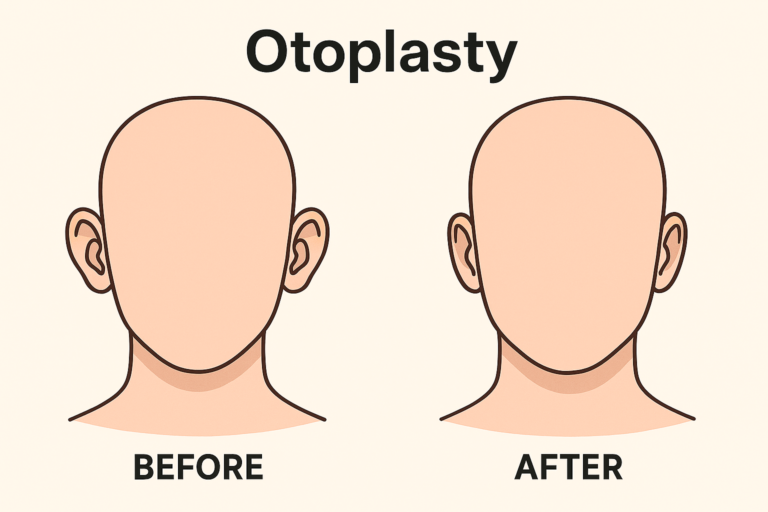
The surgery addresses the underlying cartilage framework of the ear. The most common technique involves making a discreet incision behind the ear, reshaping the cartilage (often by scoring or suturing it), and repositioning the ear closer to the head. The goal is to create a natural, symmetrical appearance that does not look “over-corrected” or “pinned back.”
The Ideal Candidate
You or your child may be a suitable candidate if there is:
Prominent, protruding ears.
Significant asymmetry between ears.
Dissatisfaction with ear size or shape (e.g., large ears, “shell ear,” or “lop ear”).
Emotional distress or self-consciousness due to ear appearance.
Surgery is typically recommended for children from around 5-6 years of age, when ear cartilage is stable, but is also commonly performed on adults.
Your Surgical Journey with Mr Ibrahim
Consultation: Mr Ibrahim will assess the ear structure, discuss your goals, and explain the surgical plan. For children, he will ensure they are comfortable and understand the process in an age-appropriate way.
Procedure: Usually performed under general anaesthesia for children and local with sedation for adults. The operation takes about 1-2 hours. The ear cartilage is reshaped using permanent sutures or scoring techniques to create a natural antihelical fold and reduce projection.
Recovery: A protective head bandage is worn for 1-2 weeks, followed by a headband at night for several weeks. Mild discomfort is managed with simple pain relief. Children can usually return to school after 1-2 weeks, avoiding sports for 6-8 weeks.
Results: Results are permanent. The ears will be closer to the head with a more natural contour. A faint scar hidden in the crease behind the ear will fade significantly over time.
Realistic Expectations & Key Considerations
Otoplasty offers a high rate of patient satisfaction. It is important to understand that perfect symmetry is not possible, as natural ears are not perfectly identical. The aim is for a significant improvement and a natural look. Risks include bleeding, infection, scarring, and rare complications like asymmetry or changes in sensation. In very rare cases, sutures can become noticeable or work loose over time, which may require minor adjustment.
1. What is the best age for a child to have otoplasty?
The ideal time is when the ear is nearly fully grown, usually around 5-6 years old. This is before school age where teasing may begin, and the cartilage is stable enough for surgery yet still malleable for shaping.
2. Are the results permanent?
Yes. Once the ear cartilage is reshaped and healed, the new position is permanent. However, trauma to the ear in the future could potentially alter the result.
3. Will the scars be visible?
The incision is made in the natural crease behind the ear. Once healed, the scar is typically very discreet and invisible from the front or side views.
4. What are the specific surgical risks?
In addition to general surgical risks, specific ones include: asymmetry, over- or under-correction, palpable or visible sutures under the skin, and very rarely, hematoma (blood collection) or infection that could affect the cartilage.
5. How long must the head bandage be worn?
A firm bandage is usually worn for 5-7 days to protect the ears and help mould the shape. After this, a lighter headband is often recommended at night for 4-6 weeks to protect the ears during sleep.
6. When can my child return to sports or swimming?
Non-contact activities can be resumed after about 2 weeks. Contact sports (e.g., football, rugby) must be avoided for at least 6-8 weeks. Swimming can usually resume once the wounds are fully healed and sealed, typically after 3-4 weeks.
7. Can the ears be made to stick out less without looking "pinned back"?
Absolutely. A skilled plastic surgeon like Mr Ibrahim aims for a natural-looking reduction in prominence, maintaining the gentle curves of the ear rather than flattening it completely against the head.
8. Is the procedure available on the NHS?
NHS funding for otoplasty is very restricted and usually only considered in cases of severe deformity or significant psychological distress with strong supporting evidence.