
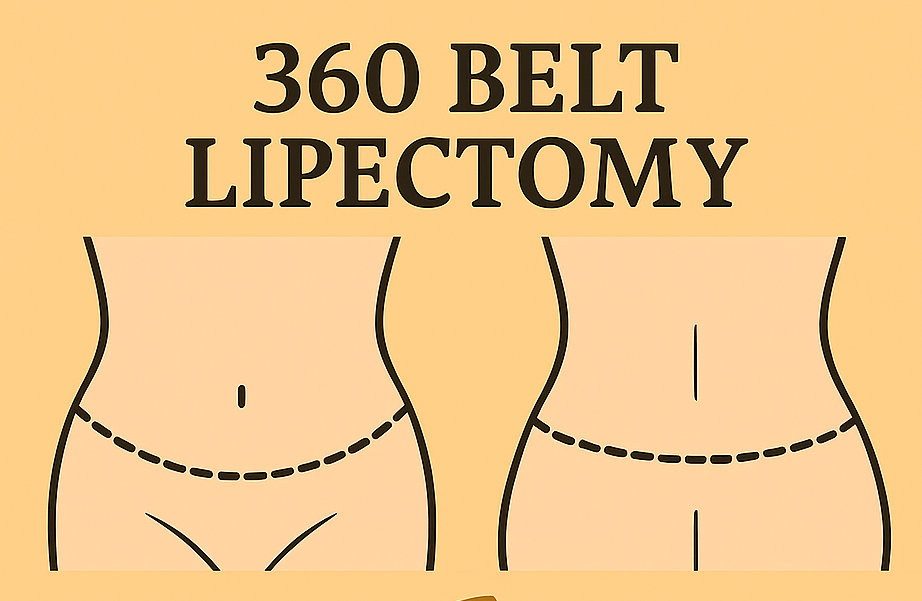
Lower Body Lift (Belt Lipectomy)
This is an extensive procedure for patients who have achieved massive weight loss and are left with significant excess skin around their entire lower torso.
- What it Addresses: The surgery removes an elliptical “belt” of skin and fat from around the entire circumference of the body, lifting the abdomen, flanks (love handles), lower back, and buttocks in a single procedure.
- The Ideal Candidate: This is suitable for patients who have lost a massive amount of weight (often 100+ lbs) through diet, exercise, or bariatric surgery, and have maintained a stable weight for at least 6-12 months. You should have significant skin laxity all around your midsection and be in good health, understanding the scale of the surgery.
- Hospital Stay & Recovery: A hospital stay of 2-3 nightsis standard. A temporary urinary catheter is often required. The recovery is more involved than a standard abdominoplasty, with patients needing 3 weeks or more off work. The scar is extensive, encircling the entire waistline.
- Realistic Expectations & Key Information: This is one of the most significant body contouring procedures with a higher inherent risk profile. The trade-off for the dramatic circumferential improvement is a permanent, noticeable scar. The results are transformative for suitable candidates.
FAQ
How is this different from a tummy tuck?
It addresses the entire lower torso circumference (abdomen, back, flanks, buttocks), not just the front. It’s for patients after massive weight loss.
Am I a candidate if I've had bariatric surgery?
Yes, but you must be at a stable weight for 12+ months and have good nutrition to ensure safe healing.
How extensive is the scar?
The scar encircles the entire body at the waistline. It is significant but fades over 12-18 months.
Why is a urinary catheter needed?
Due to the long surgery and swelling, a catheter is used for 1-2 days to ensure bladder function and hygiene.
How long is the hospital stay?
Typically 2-3 nights for close monitoring of pain, fluid balance, and initial recovery.
What is recovery like?
This is a major recovery. You’ll need significant help for 2+ weeks, avoid sitting directly on buttocks initially, and expect 3+ weeks off work.
Can it be combined with other lifts?
Often performed with an arm or thigh lift in a staged plan. Safety dictates they are rarely all done at once.
What are the major risks?
Higher risks include wound healing problems, infection, fluid collections, and blood clots due to the surgery’s scale.