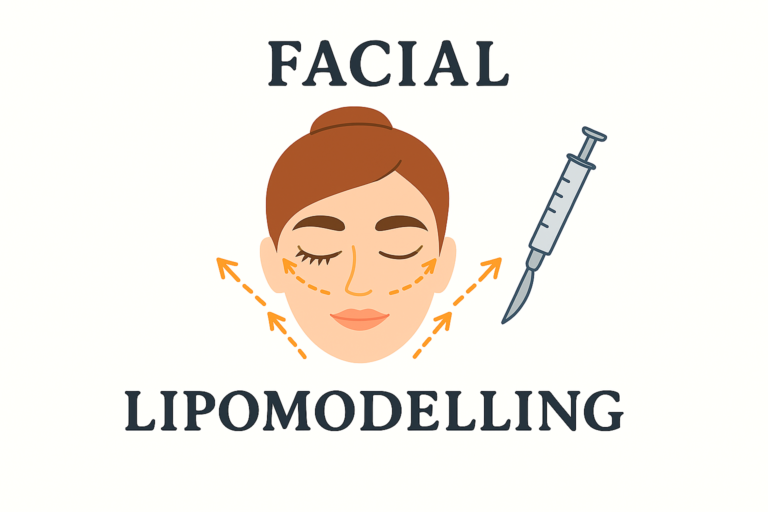
Facial Lipomodelling (Fat Transfer to the Face)
A Natural Approach to Facial Volume Restoration
Facial Lipomodelling, or autologous fat transfer, is a sophisticated procedure performed by Mr Ahmed Ibrahim. It uses your body’s own natural fat to restore lost volume, smooth contours, and rejuvenate the face, offering a natural alternative to synthetic dermal fillers.
What is Facial Lipomodelling?
The procedure involves three stages: 1) Harvesting: Fat is gently liposuctioned from a donor area like the abdomen or thighs. 2) Processing: The fat is purified to isolate healthy fat cells (adipocytes). 3) Re-injection: The processed fat is meticulously injected in tiny amounts into targeted areas of the face to replace volume lost through aging.
The Ideal Candidate
You may be suitable if you have:
Volume loss in the cheeks, temples, or under the eyes.
Nasolabial folds or marionette lines you wish to soften.
A desire for a natural, long-lasting volume enhancement.
A donor site with sufficient excess fat.
This procedure is not for significant skin laxity, which may require a facelift.
Your Surgical Journey with Mr Ibrahim
Consultation: Mr Ibrahim will assess your facial volume, skin quality, and donor sites. He will explain the process, including the variable “take” rate of fat, and set realistic expectations.
Procedure: Performed under local or general anaesthesia. The process takes 1-2 hours depending on the extent. Using micro-cannulas, fat is placed in multiple tissue layers for optimal integration.
Recovery: Donor and recipient sites will be swollen and bruised for 1-2 weeks. Most resume normal activities within a week. The majority of swelling subsides in 3-4 weeks.
Results: Initial swelling masks the result. As swelling subsides and some fat is naturally absorbed (30-50% is typical), the final, stable result is seen at 3-6 months. Surviving fat cells can last for many years.
Realistic Expectations & Key Considerations
This is a grafting procedure; not all transferred fat will survive. A degree of over-correction is often planned to account for this. Results are subtle and natural-looking. Risks include irregularity, lumps, under- or over-correction, and rare complications like infection or vascular injury. It may require more than one session for optimal volume.
FAQ
1. How long does the transferred fat last?
The fat cells that successfully establish a new blood supply (a process called graft take) are permanent and will behave like native facial fat, fluctuating with weight changes. Typically, 50-70% of the volume may remain long-term.
2. Why choose fat transfer over synthetic dermal fillers?
Fat is your own natural tissue, so there is no risk of allergy or rejection. It can provide a more holistic, three-dimensional volume restoration. While the upfront cost and recovery are greater, it can be more cost-effective over the very long term compared to repeated filler treatments.
3. How many treatment sessions will I need?
Due to variable fat survival, some patients achieve their goal in one session. Others may benefit from a planned second “top-up” session 6-12 months later to achieve optimal, predictable volume.
4. What happens if I gain or lose weight after the procedure?
The surviving fat cells will behave like other fat cells in your body. Weight gain can increase their size, and weight loss can decrease it. It is crucial to be at a stable weight before surgery.
5. What are the risks of lumps or irregularities?
This is a key risk. Lumps can form if fat is injected in large clumps or if cysts form. Mr Ibrahim uses meticulous micro-droplet injection techniques to minimise this. Most irregularities are small and can be massaged or, if persistent, surgically corrected.
6. Can it be combined with other facial surgeries?
Yes, it is an excellent complement to facelift or blepharoplasty surgery, addressing volume loss while those procedures address skin laxity. This combined approach often yields the most natural, comprehensive rejuvenation.
7. Is there a risk of fat embolism (fat entering the bloodstream)?
This is an extremely rare but serious risk. The risk is minimised by using blunt cannulas, understanding the detailed facial anatomy (especially around the eyes), and injecting small amounts with low pressure.
8. What is the recovery like for the donor site?
You will have a small liposuction incision with sutures. Bruising, swelling, and temporary numbness are common, but discomfort is usually mild.