DIEP Flap Breast Reconstruction
Breast Reconstruction Using Your Own Abdominal Tissue
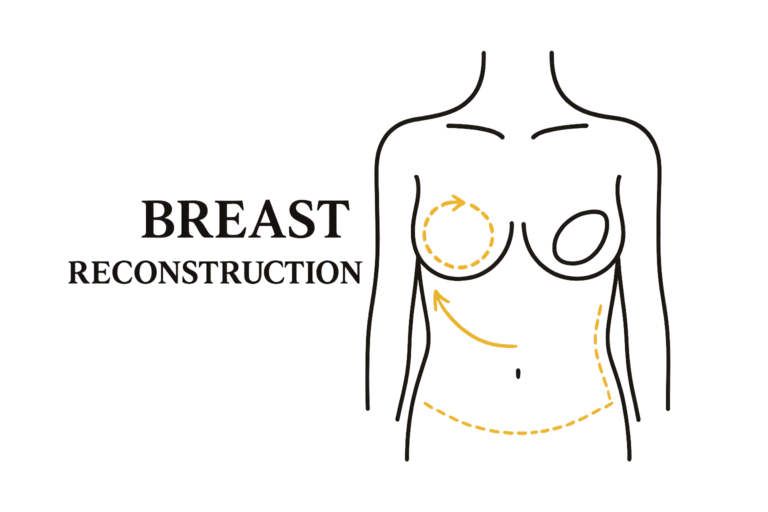
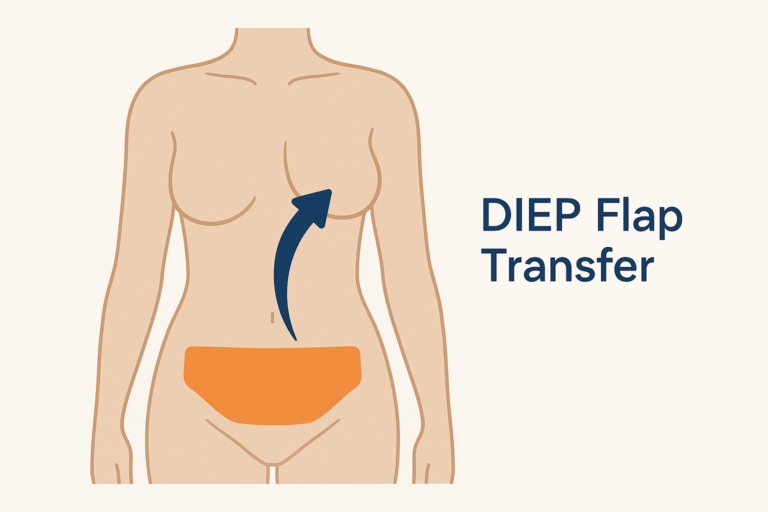
The DIEP (Deep Inferior Epigastric Perforator) Flap is widely regarded as a gold standard technique in autologous (own tissue) breast reconstruction. It uses skin and fat from your lower abdomen—similar to a tummy tuck—to create a new, soft, and natural-feeling breast. Its key advantage is that it transfers this tissue without sacrificing the underlying abdominal muscle, leading to a potentially stronger recovery and less abdominal weakness than older flap techniques.
The Microsurgical Procedure
The DIEP flap is a complex, precision operation performed by a plastic surgeon with advanced microsurgical training, such as Mr Ibrahim.
Planning & Harvesting: The skin and fat from your lower abdomen are carefully designed as an “island” of tissue. Mr Ibrahim meticulously identifies and preserves the tiny blood vessels (perforators) that supply this tissue.
Microsurgical Transfer: The tissue is completely detached from your abdomen. Under an operating microscope, its blood vessels are meticulously reconnected to new blood vessels in your chest using sutures finer than a human hair. This restores circulation and keeps the tissue alive.
Sculpting the Breast: The transferred tissue is sculpted into the shape of a natural breast mound.
Abdominal Donor Site: The abdomen is closed similarly to an abdominoplasty (tummy tuck), resulting in a flatter, tighter abdominal contour and a scar low across the bikini line.
FAQ
1. What are the main benefits of a DIEP flap?
Natural Result: The new breast is made of your own fat and skin, so it feels soft, ages naturally with your body, and often has a more natural drape than an implant.
Durability: It is a permanent reconstruction that typically does not require future replacement surgeries.
“Tummy Tuck” Benefit: The donor site offers an improved abdominal contour.
Suitable for Radiotherapy: Your own tissue is generally more resilient to the effects of radiotherapy than an implant.
2. Am I a good candidate for a DIEP flap?
Ideal candidates are generally in good health, non-smokers, and have sufficient lower abdominal tissue to create a breast mound. It is an excellent option for patients who may need or have had radiotherapy. Mr Ibrahim will assess your abdominal blood vessels with a scan to plan the surgery safely.
3. How does recovery compare to implant reconstruction?
DIEP flap surgery is a longer, more complex operation with a different recovery profile:
Hospital Stay: Usually 3-4 nights for close monitoring of the flap’s blood supply.
Initial Recovery: You will have drains at the breast and abdomen. You must avoid straining your abdominal muscles for 6-8 weeks. Walking is encouraged immediately, but bending and lifting are restricted.
Returning to Activities: Plan for 4-6 weeks off work. Full recovery and final softening of the new breast can take 3-6 months.
Strength: Recovery of core strength is gradual, but preserving the muscle leads to better long-term abdominal function than older techniques.
4. What are the specific risks of this surgery?
In addition to general surgical risks, specific ones include:
Flap Compromise: Failure rate is (1-2%). In a small percentage (5%) of cases, there can be issues with the blood supply to the transferred tissue, which may require further surgery. Your flap will be closely monitored in hospital.
Abdominal Bulge/Hernia: Although the muscle is preserved, there is a very small risk of abdominal wall weakness.
Fat Necrosis: Small areas of fat within the flap may not survive, which can feel like firm lumps.
Donor Site Scarring: You will have a scar across your lower abdomen.
5. How long does the surgery take, and will I have scars?
A DIEP flap is a lengthy microsurgical procedure, often taking 4-5 hours. You will have two scar sites:
The Breast: Scars from the mastectomy and inset of the new tissue.
The Abdomen: A horizontal scar from hip to hip, placed as low as possible, similar to a tummy tuck scar. These scars fade significantly over 12-18 months.
6. Do I need a special scan before surgery?
Yes, careful planning is essential for DIEP flap surgery. Most patients will undergo a CT Angiogram (CTA) scan or MRI (Angiography) of their abdomen. This is a specialised scan that maps the exact location, size, and pathway of the tiny blood vessels (perforators) that supply the abdominal tissue. This “roadmap” allows Mr Ibrahim to plan the safest and most efficient surgery in advance.
7. Will I lose weight or change size after a DIEP flap? Will the new breast change with weight fluctuations?
The tissue transferred is fat, not excess body weight. You will not see a significant change on the scales. However, because it is your own living fat tissue, the new breast will behave like the rest of your body. If you gain weight, it may enlarge slightly; if you lose weight, it may reduce in size. For this reason, it is very important to be at a stable weight before this surgery to achieve a stable, long-lasting result.
8. Can I have a DIEP flap if I've had previous abdominal surgery (like a C-section or Key hole surgery)?
Previous abdominal surgery does not automatically rule out a DIEP flap. It depends on the type and location of your previous scars and whether the critical blood vessels were affected. This is why the pre-operative MRI or CT Angiogram scan is crucial—it allows Mr Ibrahim to see if your blood vessels are intact and suitable for the procedure. This will be carefully assessed during your consultation. If you had a tummy tuck then you can not have DIEP flap.