Breast Augmentation
What is it?
Breast augmentation involves using implants to increase the size and improve the shape of your breasts. It can also restore volume lost after weight loss or pregnancy and create better symmetry between breasts.
What happens during surgery?
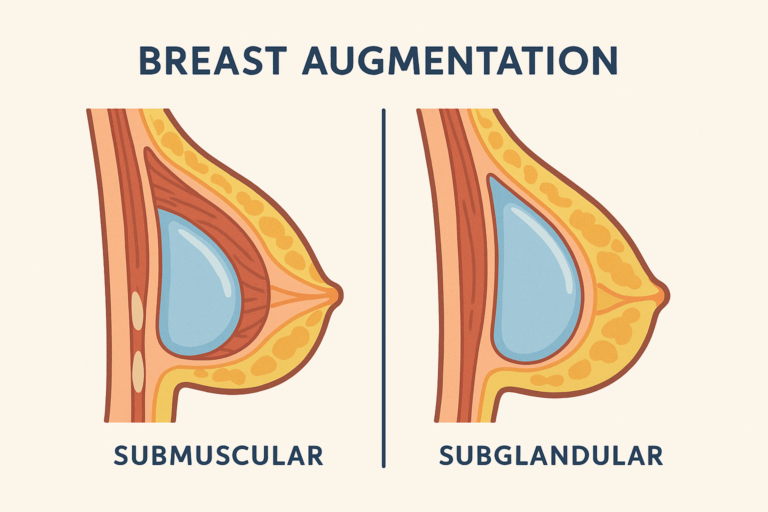
The operation is performed under general anaesthetic and takes about 60-90 minutes. Mr Ibrahim will discuss with you the most suitable implant type, size, and placement. An incision is made in a discreet location—most commonly in the crease under the breast (inframammary fold). A pocket is created either behind your breast tissue (subglandular) or beneath the chest muscle (submuscular) in selected patients. The implant is carefully positioned, and the incisions are closed with fine, dissolvable stitches.
What is the recovery like?
- Hospital Stay: Usually a day case, sometimes with one overnight stay.
- Initial Recovery (1-2 weeks): You will wear a supportive surgical bra. Expect some soreness, swelling, and a feeling of tightness. Pain is manageable with prescribed medication. Light walking is encouraged from day one.
- Returning to Work: Most patients return to non-physical, desk-based work within 1-2 weeks.
- Exercise: Avoid strenuous activity, heavy lifting, and upper body exercises for at least 4-6 weeks. Light cardio can often resume after 2-3 weeks.
- Final Results: Swelling subsides significantly within a few weeks, but implants can take 3-6 months to fully “settle” into their final position. Scars will be red initially but will fade over 12-18 months.
What are the potential risks?
General surgical risks include infection, bleeding, anaesthetic reaction, and scarring. Specific risks include capsular contracture (where scar tissue tightens around the implant), implant rupture or leakage (rare), changes in nipple or breast sensation, asymmetry, and the potential need for further surgery in the future. Mr Ibrahim will discuss all these in detail during your consultation.
FAQ
1. What types of breast implants are available, and how do I choose?
Mr Ibrahim uses FDA and UKCA-approved implants, primarily silicone gel (cohesive, natural feel). Choices include round or anatomical (teardrop) shapes, and various projection profiles. The best choice depends on your anatomy, desired look, and Mr Ibrahim’s professional recommendation.
2. Where will the incision be placed?
Incisions can be placed in the inframammary fold (under the breast, most common), which is very discreet.
3. Where will the implant be positioned?
Implants are placed either subglandular (over the chest muscle) or submuscular/subpectoral (under the muscle). Mr Ibrahim will discuss with you the pros and cons of each and the suitable recommended placement. Placement under the gland is the standard practice if there is enough breast tissue to cover the implant. Placement under the muscle is more common in very slim women as it can provide more soft tissue coverage over the implant and reduce the rippling and folding of skin over the implant, but can cause animation deformity (implant movement with muscle contraction).
4. What are the risks specific to breast implants?
Key risks include: Capsular contracture (scar tissue hardening around the implant), implant rupture or deflation, breast implant-associated anaplastic large cell lymphoma (BIA-ALCL) (a very rare lymphoma), implant rotation (for anatomical shapes), and changes in nipple sensation.
5. Will I need to have my implants replaced in the future?
Breast implants are lifetime devices if they are not causing you any problems and you are happy with their shape. While many last for 10-20 years or more without issue, you will likely need further surgery at some point to replace or remove them due to rupture, capsular contracture, or a desire for a size change.
6. How do I decide on the right size for me?
Size is discussed in terms of desired cup size change and overall body proportion. Mr Ibrahim uses techniques like implant sizers during your consultation to help you visualise potential outcomes. The final decision balances your aesthetic goals with what is surgically safe and proportionate for your frame.
7. What is the recovery like after breast augmentation?
You can go home the same day or after one night. You’ll wear a support bra. Plan for 1 week off work. Avoid heavy lifting and upper body exercise for 4-6 weeks. Implants may initially sit high and feel firm before settling into a more natural position over 2-3 months.
8. Will breast augmentation affect mammogram screenings?
Implants can obscure some breast tissue during a standard mammogram. It is crucial to inform your screening radiographer that you have implants so they can use additional displacement views (Eklund views), which is effective in picking up any lesions in the breast while having breast implants. Breast implants do not increase your risk of breast cancer.