Blepharoplasty (Eyelid Surgery)
Refresh Your Gaze, Restore a Youthful Appearance
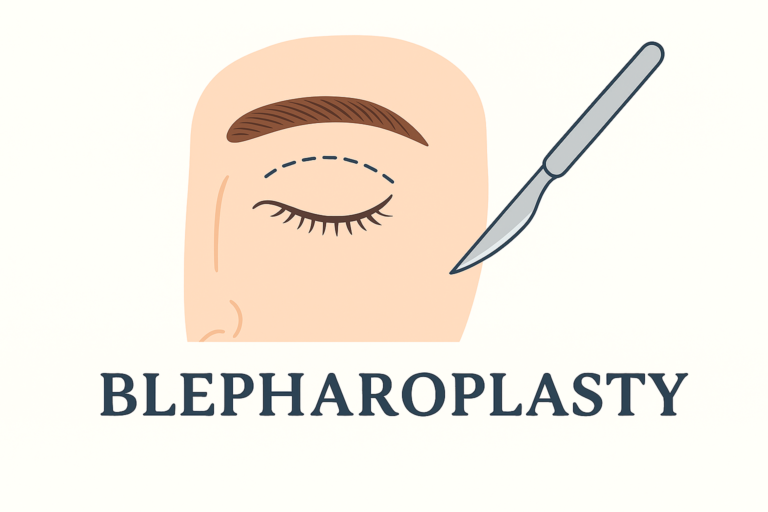
Blepharoplasty is an eyelid surgery performed by Consultant Plastic Surgeon Mr Ahmed Ibrahim to remove excess skin, fat, and muscle from the upper and/or lower eyelids. This procedure addresses hooded, tired-looking eyes, under-eye bags, and can significantly refresh the overall appearance of the face.
What is Blepharoplasty?
Upper Blepharoplasty: An incision is made in the natural crease of the upper eyelid to remove excess skin and protruding fat. The scar becomes virtually invisible within the crease.
Lower Blepharoplasty: Addresses under-eye bags and loose skin. The incision is usually made just below the lash line or inside the eyelid (transconjunctival approach, leaving no visible scar) to redistribute or remove fat and tighten skin.
The Ideal Candidate
You may be suitable if you have:
Upper lids: Hooded skin that impairs peripheral vision or creates a tired appearance.
Lower lids: Puffy “bags” caused by herniated fat, or loose, crepey skin.
Good general health, realistic expectations, and no serious underlying eye conditions (e.g., dry eye syndrome must be assessed and managed).
Your Surgical Journey with Mr Ibrahim
Consultation: A thorough assessment of your eyelids, vision, and eye health. Mr Ibrahim will discuss your goals, explain the specific techniques for you, and manage any pre-existing conditions like dry eyes.
Procedure: Usually performed under local anaesthesia with sedation. Upper blepharoplasty takes about 1 hour; combining upper and lower takes 2-3 hours. Incisions are meticulously placed for minimal visibility.
Recovery: Swelling and bruising are common for 7-14 days. Sutures are removed around day 5-7. Most return to social activities after 10-14 days. Strenuous activity should be avoided for 3-4 weeks.
Results: A fresher, more alert, and youthful appearance. Final results are seen after 2-3 months once all swelling has subsided. Results are long-lasting, though the eyelids will continue to age naturally.
Realistic Expectations & Key Considerations
Blepharoplasty is a precision procedure with high satisfaction rates. It is crucial to understand it does not eliminate crow’s feet or lift the eyebrow (which requires a brow lift). Risks include temporary dry eyes, irritation, visible scarring, asymmetry, difficulty closing the eyes (rare and usually temporary), and in extremely rare cases, visual changes.
FAQ
1. Will blepharoplasty get rid of my dark circles?
Surgery can improve shadows caused by protruding fat pads, but it cannot change skin pigmentation (true dark circles). Tear trough nanofat grafting or filler or skin treatments may be better for pigment-related darkness.
2. What is the difference between the transconjunctival and external lower lid approaches?
The transconjunctival incision is inside the eyelid; it leaves no visible scar and is ideal for patients who only need fat removal, not skin tightening. The external (subciliary) incision below the lashes allows for skin removal and muscle tightening but leaves a fine-line scar.
3. Is the surgery painful?
Discomfort is typically minimal—often described as a gritty, tight feeling. Pain is well-controlled with simple analgesics.
4. What are the key risks to my vision?
Temporary blurry vision from ointments or swelling is common. Serious complications like retrobulbar hematoma (bleeding behind the eye) are extremely rare but require immediate treatment. Dry eye syndrome can be exacerbated and must be managed pre- and post-op.
5. When can I wear contact lenses or eye makeup?
Contact lenses should be avoided for at least 2 weeks. Eye makeup can usually be resumed after 10-14 days, once the incision lines are fully closed.
6. Can it be combined with other facial surgeries?
Yes, it is very commonly and effectively combined with a brow lift, facelift, or facial lipomodelling for a harmonious, comprehensive facial rejuvenation.
6. Will I look "overdone" or surprised?
Mr Ibrahim’s philosophy is to achieve a natural, refreshed result. Over-resection of skin or fat can lead to a hollow, startled look. His meticulous, conservative approach aims to preserve your natural anatomy while addressing your concerns.
8. Is eyelid surgery ever medically necessary?
Yes. When excess upper eyelid skin (dermatochalasis) significantly obstructs the peripheral visual field, surgery can be considered functional. This may be eligible for NHS funding with supporting visual field tests from an ophthalmologist.