
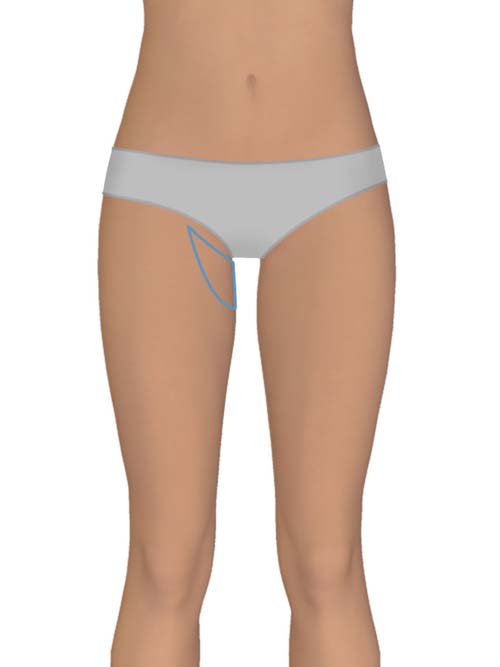
Breast Reconstruction with Upper Inner Thigh Flaps (PAP/TUG)
A Natural Autologous Reconstruction with a Thigh Donor Site
Breast reconstruction using tissue from the upper inner thigh—specifically the PAP (Profunda Artery Perforator) or TUG (Transverse Upper Gracilis) flaps—is a sophisticated autologous technique performed by Consultant Plastic Surgeon Mr Ahmed Ibrahim. This procedure uses your own skin and fat from the inner thigh to create a soft, natural-feeling breast, while simultaneously contouring the donor area.
What are PAP and TUG Flaps?
These are perforator flaps, meaning the blood supply to the tissue is carefully preserved through tiny perforating vessels from a deeper artery.
PAP Flap (Profunda Artery Perforator): Uses skin and fat from the upper inner thigh, supplied by perforators from the profunda femoris artery. It spares the underlying gracilis muscle entirely, aiming for a faster recovery with minimal impact on leg function.
TUG Flap (Transverse Upper Gracilis): Uses a transverse ellipse of skin and fat from the upper inner thigh, along with a small portion of the underlying gracilis muscle (a minor thigh adductor muscle), based on a named blood vessel.
Both techniques create a well-hidden scar in the inner thigh crease and can provide excellent volume for a natural breast mound, often without the need for an implant.
The Ideal Candidate
You may be an excellent candidate for a PAP or TUG flap reconstruction if:
You desire a completely natural, autologous reconstruction but do not have sufficient abdominal tissue for a DIEP flap.
You have good-quality tissue (skin and fat) in your upper inner thighs.
You are a non-smoker or can stop well in advance, as smoking critically compromises blood vessel health and healing.
You wish to avoid an implant or have had issues with implants in the past.
You would like improvement in the contour of your inner thighs along with breast reconstruction.
Your Surgical Journey with Mr Ibrahim
Consultation & Planning: Mr Ibrahim will conduct a thorough assessment of your breasts and thighs. Advanced imaging like CTA (CT angiography) is often used to meticulously map the blood vessels in your thighs, ensuring the safest surgical plan. He will discuss the nuances of PAP vs. TUG and recommend the optimal flap for your anatomy.
Procedure: This is a complex microsurgical procedure performed under general anaesthesia. It involves two surgical teams working simultaneously: one prepares the chest, while the other harvests the flap. The blood vessels of the flap are then meticulously connected to vessels in the chest under a microscope (microvascular anastomosis). Surgery typically lasts 6-9 hours.
Hospital Recovery: You will be closely monitored in a specialist ward for 5-7 days. The flap’s circulation is checked frequently. You will have drains in both the breast and thigh. Early, careful mobilisation is encouraged to promote healing.
Home Recovery & Long-Term Results: Recovery requires patience. You must avoid straining the thigh for 6-8 weeks. Swelling in both sites gradually subsides over months. The final breast shape and thigh scar mature over 12-18 months. A second procedure for nipple reconstruction and final refinements is common.
Realistic Expectations & Key Considerations
This is a major, life-enhancing surgery, but it requires a clear understanding of the process:
Natural Results: The breast will feel soft, warm, and natural, and will fluctuate with weight changes.
Thigh Donor Site: You will have a scar in the inner thigh crease. There will be a permanent change in contour. Thigh strength is usually well-maintained, especially with the PAP flap, though some temporary tightness or numbness is common.
Symmetry: Perfect symmetry is challenging; a procedure on the opposite breast (reduction, lift) or thigh may be suggested for the best match.
Risks: As with all microsurgery, there is a risk of flap failure (loss of the tissue) due to blood clot formation at the vessel connection, though this is rare (typically <2-3% in experienced hands). Other risks include bleeding, infection, scarring, and donor site healing issues.
FAQ
1. How is a PAP/TUG flap different from a DIEP (abdominal) flap?
The DIEP flap uses abdominal tissue, leaving a tummy-tuck like scar. The PAP/TUG flap uses inner thigh tissue. The choice depends on where you have excess tissue, your body shape, and the quality of your blood vessels. The thigh can be an ideal donor site for slimmer patients without excess abdominal tissue.
2. What are the key differences between the PAP and TUG flap?
The PAP flap is a perforator flap that spares the gracilis muscle entirely, potentially leading to an easier recovery for the leg. The TUG flap includes a small, non-essential portion of the gracilis muscle, which can make the blood vessel connection slightly more robust.
3. Why might I choose a thigh flap over an implant-based reconstruction?
An autologous reconstruction like PAP/TUG uses your own living tissue, so it feels more natural, ages with you, and has no risk of implant-related complications like capsular contracture, rupture, or the need for future replacement. It also recreates a breast without a foreign body.
4. What are the specific risks to my leg function?
Most patients regain excellent leg function. With the PAP flap, impact is minimal. With the TUG flap, you may experience temporary tightness when bringing your legs together or climbing stairs, which usually resolves. Numbness of the inner thigh skin is common but often improves.
5. How is the scar on the thigh positioned?
The scar is designed to lie within or just below the natural crease of the upper inner thigh, making it discreet and easily concealed by clothing, swimwear, or underwear.
6. Can I have this reconstruction if I've had radiotherapy?
Yes. Bringing healthy, non-irradiated tissue from the thigh to the chest is often an excellent strategy for reconstructing a radiated breast, as it replaces damaged skin and provides a healthy blood supply to the area.
7. What is the recovery timeline?
Hospital stay: 5-7 days.
Walking: Assisted walking begins at day 2-3; avoid strenuous leg activity for 6-8 weeks.
Driving: Typically after 4-6 weeks.
Desk work: Possibly at 4-6 weeks.
Full activities: May take 3-6 months.
8. Is this procedure available on the NHS?
The availability of specific perforator flap reconstructions like PAP/TUG can vary across NHS trusts and may depend on specialist microsurgical expertise. All women have the right to a discussion about all reconstructive options. Mr Ibrahim perform this type of reconstruction in his NHS practice at Nottingham University Hospitals NHS trust.